Taking Your Bird Outdoors Safely: A Practical Guide
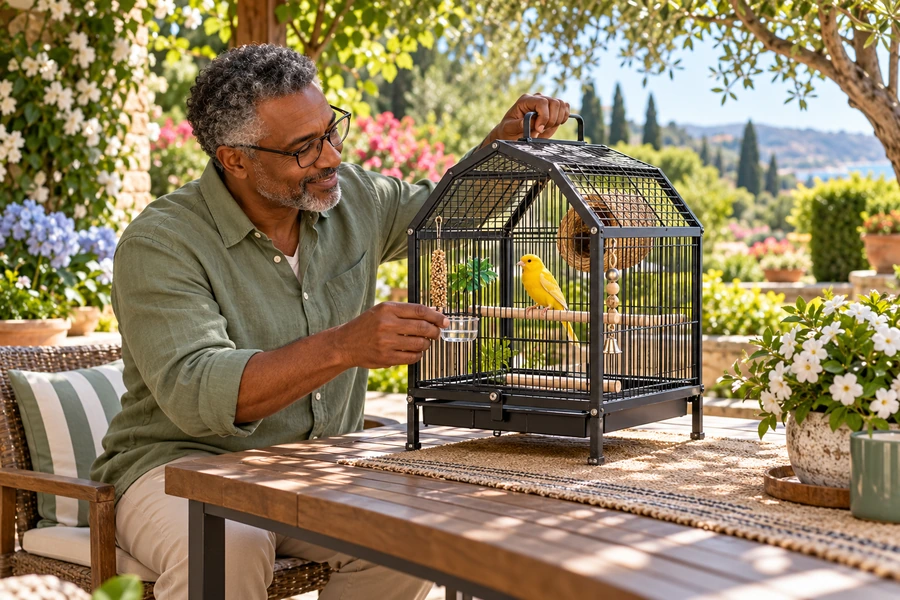
Time outdoors can be genuinely valuable for a pet bird. Natural daylight, moving air and an entirely new set of sights and sounds provide stimulation that no indoor setup can match. But outdoor time carries real risks, and they deserve respect. Here is how to do it properly with a portable cage like the Luxury Portable Bird Cage.
Why outdoor time helps
Most pet birds spend their entire lives under artificial light, in still air, looking at the same room. Short, supervised outdoor sessions break that monotony considerably.
Owners frequently report more vocalisation, more activity and better appetite in the days following outdoor time. Natural daylight is also relevant to vitamin D synthesis, though window glass filters out most of the useful wavelengths, which is precisely why going outside is different from sitting by a window.
Rule 1: Always supervise
Never leave your bird outdoors unattended, not even for a few minutes. Cats, hawks, crows, raccoons and loose dogs can appear fast, and a predator does not need to get inside the cage to cause fatal stress.
Stay within arm’s reach. Treat it the way you would treat a toddler by a pond.
Rule 2: Provide shade
Birds overheat quickly and cannot sweat. Position the cage so that part of it is shaded and your bird can choose between sun and cover. Avoid the middle of the day entirely in summer.
Signs of overheating include panting, holding the wings away from the body and obvious lethargy. If you see any of these, bring the bird inside immediately.
Rule 3: Check the weather
Skip outdoor time in strong wind, rain, or temperature extremes in either direction. Mild, still days are what you want. Wind in particular is stressful for birds, who read sudden movement of surrounding objects as a threat.
Rule 4: Secure the cage
Check that every door and food hatch is closed and properly latched before you lift the cage. Do this every single time. The iron construction gives you a reliable, rigid structure, but a latch left open is a latch left open.
Place the cage on a stable surface outdoors, never on uneven ground where it might tip.
Rule 5: Start small
Begin with ten to fifteen minutes and watch your bird’s body language closely. A relaxed bird preens, chirps, eats and looks around with interest. A stressed bird flattens its feathers tight to the body, pants, freezes or thrashes against the bars.
Build the duration gradually across several sessions rather than all at once.
Rule 6: Bring fresh water
Always provide fresh water outdoors and check it often, particularly in warm weather. Water heats quickly in a small container in direct sun.
Back inside
When you return, put the cage back in its usual position so your bird has the reassurance of familiar surroundings. The portable design makes this routine straightforward enough to repeat regularly, which is where the benefit actually comes from.
Build it into a routine
Birds benefit far more from short outdoor sessions several times a week than from one long session a month. Twenty minutes on a mild morning, repeated regularly, does more for a bird’s wellbeing than an occasional afternoon outdoors.
The portability of the Luxury Portable Bird Cage is what makes that frequency realistic, since a cage that takes two people and fifteen minutes to move will simply never go outside.
If other pets share the home, think about their routines too. Outdoor spaces designed for several species need planning, and our guide to creating a safe outdoor space for your rabbit applies similar principles.










Leave a comment