How to Stop Your Cat Scratching the Furniture (without Punishment)
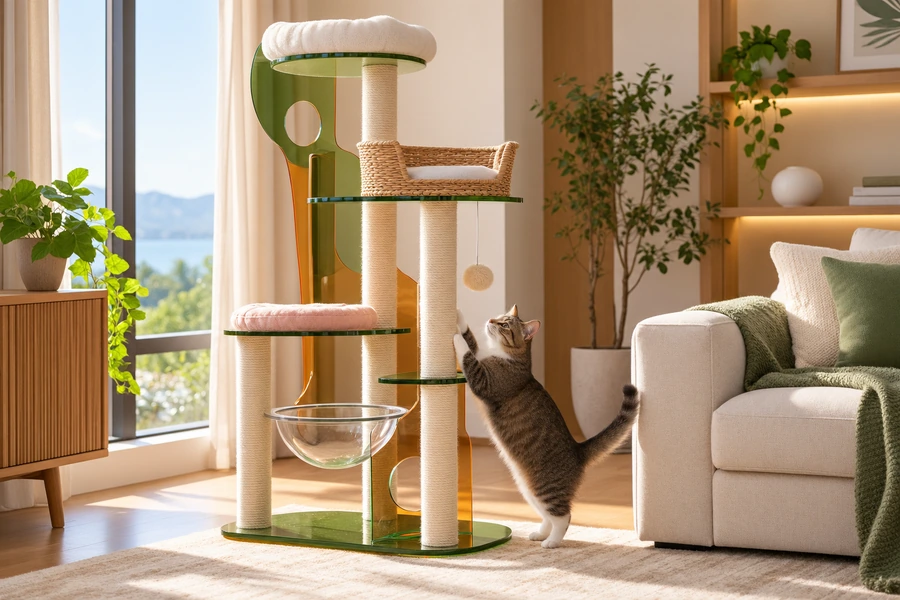
Scratching is not bad behaviour. It is how cats shed the outer sheath of their claws, stretch the muscles along their back and shoulders, and leave scent marks from glands in their paws. You will never stop a cat from scratching, and you should not try. What you can do is decide where it happens.
Why punishment does not work
Shouting, clapping or spraying water produces anxiety rather than understanding. Your cat does not conclude that scratching is wrong. They conclude that scratching while you are watching is risky, and they scratch the same sofa the moment you leave the room.
Worse, you have now become part of the stress, which tends to increase scratching rather than reduce it. Redirection works far better and takes less effort.
Step 1: Offer a genuinely better surface
Cats prefer tall, rigid surfaces they can stretch against at full length, with a coarse vertical texture. Sisal is the usual favourite.
The Luxury Acrylic Cat Tree House includes dedicated sisal scratching areas on a stable frame tall enough for a full stretch. The stability is the critical part. A post that tips or wobbles will be abandoned in favour of the sofa, which never moves.
Step 2: Place it where they already scratch
Put the new option directly beside the furniture your cat has been targeting. Not in another room, not tucked in a corner. Beside it.
Cats also scratch near sleeping spots and at room entrances as part of territorial marking, so consider those locations too once the main problem area is covered.
Step 3: Make the furniture temporarily less appealing
Cover the targeted spot with a throw, a piece of furniture film or double-sided tape for a few weeks. Most cats dislike the sticky sensation and move to the better option nearby. Remove the covering once the habit has shifted.
Step 4: Reward the right choice
When your cat uses the sisal, praise them or offer a treat straight away. Timing matters more than the size of the reward. A little catnip rubbed into the scratching surface helps attract initial interest.
Step 5: Keep claws trimmed
Regular nail trims reduce the damage any stray scratch does while you are retraining. If your cat finds handling difficult, our guide to grooming an anxious pet covers how to build tolerance for paws being touched.
Step 6: Check for underlying boredom
Heavy scratching is sometimes a stress or energy signal rather than a simple grooming behaviour. A cat with nothing to do will scratch more. Adding exercise often reduces the problem on its own, and our article on training your cat to use a cat wheel is a good starting point if that sounds familiar.
Why a full cat tree beats a single post
A small post may satisfy a kitten, but an adult cat wants height, variety and somewhere to rest afterwards. A multi-tier tree combines scratching, climbing and sleeping in one place, which means it earns its floor space several times over. At 80 x 60 x 169 cm, this one gives your cat a complete territory of their own.
Step 7: Give it time and keep it consistent
Habits take weeks to shift, not days. Leave the new scratching surface exactly where it is for at least a month, and resist moving it to a tidier spot the moment things improve. Consistency is what makes the change stick.
Multi-cat households often need more than one scratching option, since cats will not reliably share a marking post. The tiered design of the Luxury Acrylic Cat Tree House helps, because several cats can use different levels at once without competing.
Protect your furniture by giving your cat something better, not by making your home stressful. See the Luxury Acrylic Cat Tree House.













Leave a comment