Crate Training Made Easier: Turning the Crate into Your Dog’s Favorite Spot
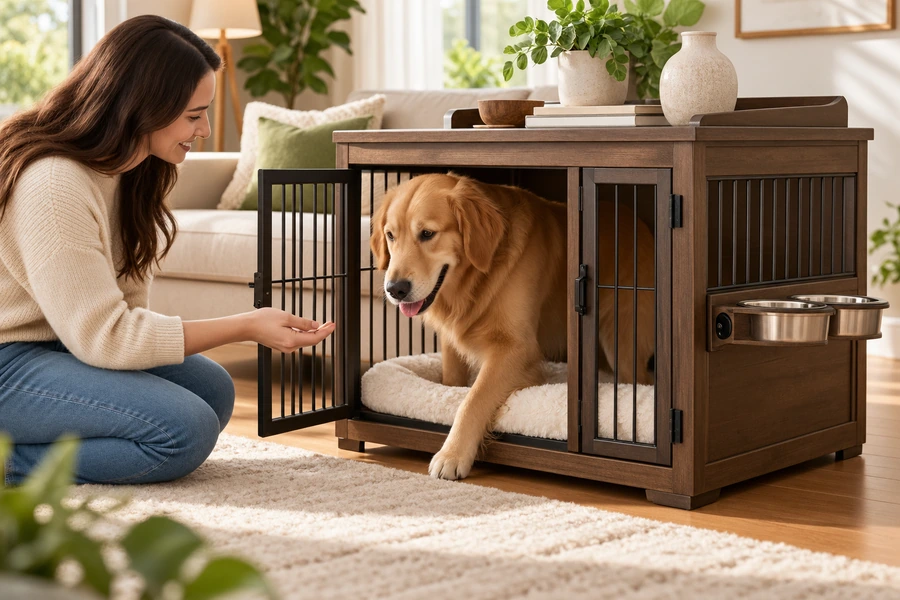
Crate training has an image problem, and some of it is deserved, because plenty of people have done it badly. Done properly, a crate is not confinement. It is a quiet, defined den that your dog chooses to rest in, the way a wild canid chooses a burrow. Here is how to build that association from the start.
Start with the right crate
A crate must be large enough for your dog to stand, turn and lie down fully. Too small and no amount of training will make it comfortable. Too large and it stops feeling like a den.
The 41″ Wooden Dog Crate End Table is designed for medium to large dogs and includes a soft cushion, so the space is inviting from the first day rather than something you have to improve afterwards.
Step 1: Put it in a shared room
Dogs are social animals, and isolation is the fastest route to crate anxiety. Place the crate in the living room or wherever the family actually spends time, not in a garage, utility room or spare bedroom.
This is precisely where furniture-style crates earn their keep. Because it functions as a table, you can put it in the main room without the room suffering for it.
Step 2: Leave the doors open
For the first few days, do not close anything. Let your dog wander in and out freely. Toss treats inside at random intervals so that good things keep appearing there.
The double-door design helps here, because more than one exit makes the space feel markedly less confining to a cautious dog.
Step 3: Feed meals in the crate
Use the 360° rotating bowl holder to serve meals inside. Food is the strongest positive association available, and within a week most dogs will walk into the crate the moment they hear the bowl.
Step 4: Close the door briefly
Once your dog is eating calmly inside, close the door for a minute or two while you stay in the room. Open it before they ask. Then extend gradually: five minutes, ten, twenty.
If your dog whines, wait for a pause before opening. Opening mid-whine teaches that whining works.
Step 5: Build up to longer stays
Practise short absences. Step outside for the post, walk to the end of the street, return without any fuss. Low-key departures and low-key returns are what keep a crate boring in the best possible way.
Golden rules
- Never use the crate as punishment, ever.
- Do not leave your dog crated longer than they can comfortably manage.
- Exercise before crate time, not after.
- Remove collars with tags before crating to avoid snagging.
- Keep the bedding clean and dry, which is easy with a removable tray and washable cushion.
Build the wider routine
Crate training works best as part of a predictable day. A dog with adequate exercise and a reliable outdoor space settles far more easily indoors, and our article on building a backyard retreat your dog will love covers the outdoor half. If your dog travels with you, a familiar den away from home helps enormously, and the fold-flat kennel that goes wherever you go explains that option.
Troubleshooting the common problems
If your dog barks whenever the door closes, you have moved too fast. Drop back to the previous stage for a week. If your dog settles happily but refuses to go in unprompted, keep feeding meals inside for longer.
A dog who scratches at the tray is usually under-exercised rather than distressed. Walk first, crate second.
The removable tray and washable cushion on the 41″ Wooden Dog Crate End Table make the inevitable accidents of the first few weeks a minor issue rather than a reason to give up.
Over time, most dogs take themselves to the crate for naps without being asked. That is the goal. Shop the crate end table.









Leave a comment